Q&A with Mumsnet
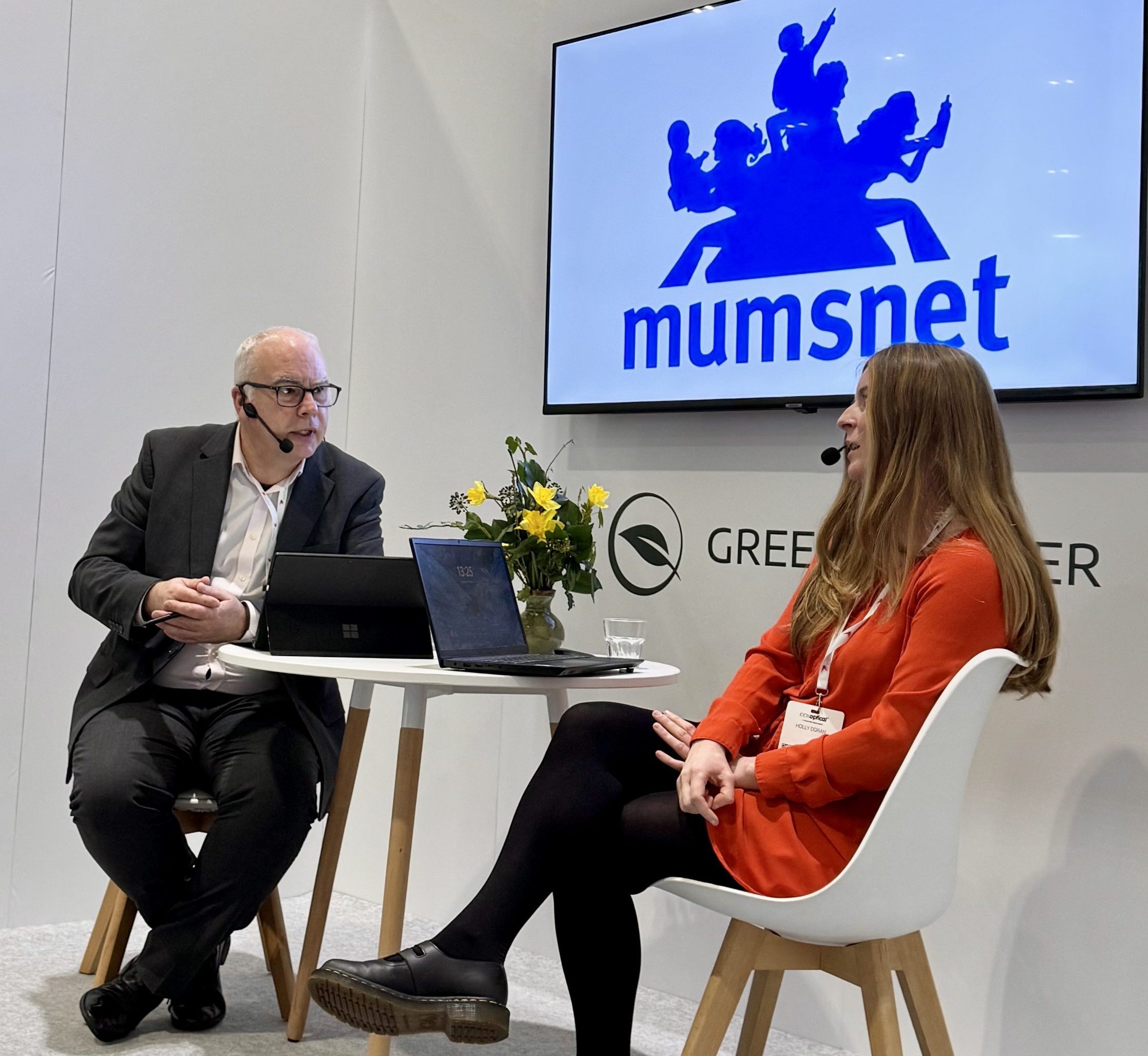
ABDO’s Max Halford with Holly Doran of Mumsnet on the OSA stand at 100% Optical
Mumsnet research manager, Holly Doran, joined ABDO clinical and policy director, Max Halford, on the Optical Suppliers Association (OSA) stand at 100% Optical last month to discuss its recent collaboration with ABDO, the OSA and the College of Optometrists to raise awareness of children’s vision.
As reported in the March issue of Dispensing Optics, the optical organisations have worked together to engage the parenting platform to help promote awareness of children’s vision and related eye health issues.
As part of the project, Mumsnet researchers datamined nearly 8,000 conversations about children’s vision that had taken place on the platform over the past five years. In addition, Mumsnet has undertaken a survey of its members to gauge their understanding about the importance of regular eye examinations, the role of different eyecare professionals and their knowledge of myopia control.
Interesting insights
With a 20-plus year history of campaigning, Mumsnet is long experienced in tapping into what it calls ‘pain points’ experienced by parents – whether it be in the workplace or in society at large. Its campaigns are often cited in parliament, and the organisation receives around 200 mentions in the press each year.
In a Q&A with Max Halford at 100% Optical, Holly explained that the platform was well placed to cover paediatric research topics – having previously been involved with children’s mental health research.
On the data-mining exercise about children’s vision, Holly explained that conversations on the topic seemed particularly emotive – and that in conversations about myopia management, users would primarily use brand names, highlighting the impact of product marketing.
“It was interesting to see that myopia control brands were mentioned a lot more frequently on the site than general terms such as ‘myopia control glasses’ or ‘myopia control contact lenses’,” said Holly. “This could suggest that while people are increasingly familiar with specific branded products, they may still not be familiar with the broader category of myopia control products and how they work.” Explaining more about the follow-up survey, Holly revealed that 1,008 users responded to a set of broad, open questions. More than 100 users also shared further thoughts at the end of survey.
“We could see how engaged respondents were with the topic based on how they responded to the open question we put at the end of the survey asking people if they had anything else to share on the topic,” explained Holly.
“We had a number of people say they were happy Mumsnet was covering the topic and others saying they were really keen to see the results, so they knew how best to take care of their children’s eye health. Q&A with Mumsnet “This shows how keen parents are to move away from the confusion they feel, and to feel empowered on all things related to children’s eye health,” she added.
Confusions revealed
Holly also revealed that parents showed confusion in lots of different areas.
“They [survey respondents] were confused about when children should first get their eyes tested, how often they should be going, and about the roles of different eyecare specialists, with people using the terms ‘optician’ and ‘optometrist’ interchangeably,” she said. “People also used ‘squint’ and ‘lazy eye’ interchangeably, even in cases where their children had one of these conditions. Again, this suggests people think they are the same thing.”
When asked about the one thing that particularly struck her from the results of the data mining exercise, it was the level of parental guilt around any diagnoses that their children had received. “Parents often felt they had failed their children by not spotting the issues fast enough,” Holly said. “Instead of cutting themselves slack over the conflicting advice they’re exposed to, they put a lot of the blame on themselves. I think this really underlines how valuable it would be to them to receive more education on children’s eye health.”
Speaking after the event, Max Halford said: “It has been a great experience collaborating with Mumsnet and its members. The insights gained from both the initial data mining and the follow-on survey will enhance our ability to target messages about children’s eye health with greater precision.
“While many parents understand the importance of regular visits to their High Street opticians, there remain areas where confusion persists around broader eye health. Both dispensing opticians and optometrists are in a strong position to help address these gaps in knowledge, providing crucial support to parents and ensuring the best possible long-term eye health for children,” he added.
Report coming soon
Later this month, ABDO, the College of Optometrists, and the OSA, supported with data obtained from Mumsnet users, will launch a public awareness campaign to raise the profile of children’s eye health.
The campaign aims to encourage parents to prioritise regular eye examinations for their children while also addressing broader issues in paediatric eyecare, including the importance of registrant-led dispensing and attitudes toward myopia and other eye conditions.
In preparation for the campaign launch, ABDO will support its members by highlighting available resources to help dispensing opticians deliver exemplary children’s eyecare in their practices.
Rhiannon Evans, head of communications and public affairs at Mumsnet, commented: “We’re pleased to be collaborating with the College of Optometrists, ABDO, and the OSA, using our unique insights to drive meaningful improvements in the next generation’s vision and ocular health outcomes.”