Business Bites: Work-life balance

Identify the important areas of your life that are being neglected
Life is busy and you are highly focused on specific areas that are consuming all of your energy and time. These situations can often lead to having a poor work-life balance, and not paying enough attention to all the other areas in your life.
However, it is important not to neglect certain parts of your life that are important. Many people complain of a poor work-life balance, but how do you quantify this – and how do you rebalance?
Wheel of Life
The Wheel of Life is a tool to help you visualise the important areas of your life all at once. The wheel helps you to better understand which important areas are thriving, and which are being neglected and need the most work.
It consists of six to eight areas that you have chosen as important for a worthwhile and successful life and helps you to identify how much time you should spend on a certain category in relation to others. Self-reflection using the wheel allows you to find out what to change in a certain part of your life in order to become happier and more fulfilled.
The original concept of the Wheel of Life was the creation of Paul J. Meyer, who founded the Success Motivation Institute in 1960. Today, different variations of the wheel are used.
Choosing a wheel design
A Wheel of Life sometimes resembles a pie chart, with each ‘slice’ representing an area you have identified as important to you. Other times, it is shown as a ‘spider web diagram’ with lines joining the scores of each section.
The following advice on building a personal Wheel of Life is sourced from a 2024 article by the Indeed Editorial Team.
To create your wheel, you must determine your life wheel design and your medium. For example, you can choose between using an online generator or a pen and paper. Ultimately, you want to choose a design that’s easy for you to read.
The two most common styles for a Wheel of Life are the spider web and the pie.
In the spider web, a single line represents each category of your life and runs from the centre of the page to the outer border to form a diagram that looks similar to a spider web. With this type of wheel, you place a dot within each category to identify your current prioritisation of that area of your life. When imbalances occur, the shape of your connected dots differs.
The pie, also called the original style, resembles a pie with sections. These sections look like a pie cut into slices, with each slice assigned a different category in your life. You then adjust the size of each slice to reflect how much time you dedicate to it, in addition to the importance of each category.
Choosing your categories/areas
There are many areas that you may chose and a few examples are listed below:
- Health
- Environment
- Career and business
- Relationships
- Personal development and self-growth
- Money
- Creativity
- Fun and recreation
- Attitude
- Mental state
- Lifestyle
- Life vision
- Emotional well-being
- Contribution to society
This list is simply a guide and you can choose other areas that are more important to you. These areas can be based on:
- The roles they are playing in your regular routine
- Areas of life which you feel important
- Current and new priorities in life
Scoring your categories/areas
Once you have identified your areas, this is where you need to be honest during some self-reflection to decide scores for each area. A suggested method of scoring is shown below:
- Scores ranging from eight to 10: you are extremely satisfied in that category. Ensure this is maintained, however, there’s always room for improvement
- Scores ranging from five to seven: you are more or less satisfied with this category; however, there is definitely room for improvement and an opportunity for further development
- Scores ranging from one to four: you are not happy at all about this specific area; you definitely need to find approaches to improve the fulfilment here
The scores offer you the chance to think about areas in your life that have been overlooked so far.
Taking action
The following questions should help you to dig deeper but more importantly form some SMART goals and an action plan in order to rebalance your wheel.
• Why did you give yourself such a low score on a category?
• What score would you like to accomplish in future by a set date?
• What is your perfect score for each category? (note: it may not be 10)
• Which category should you focus on first?
Using this visual tool, you can decide the areas in your life that need more of your time and attention. You can then plan changes that help you work towards your ideal prioritisation.
Some people find it useful to work with a coach on this exercise and the review of progress.
An example of the wheel is seen below:
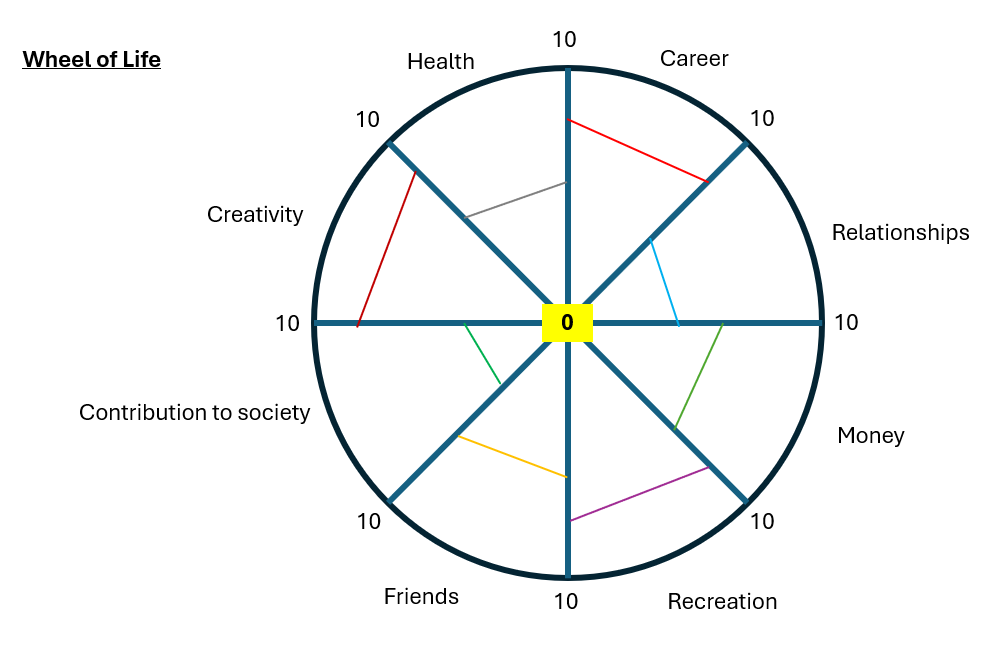
The centre of the wheel is 0 (very dissatisfied) and the outer edge 10 (fully satisfied)
Life Coach Directory offers a template that can be found here.
A third-party interactive assessment for the Wheel of Life can be found here.
Other useful links
Nash J. What are your personal values?’ Harvard Business Review November 2020.
Nicholls K. Wheel of life tool. Life Coach Directory.