Business Bites: Time management

Make a plan and communicate it effectively with your teams
“Time is the scarcest resource, and unless it is managed, nothing else can be managed,” states Peter Drucker in his book, The Effective Executive.
Time is both finite and measurable. Your time, and the time of your team, is not limitless so prioritisation is key – as is the sharing of resources across your business to maximise the time resource available as a whole.
According to the McKinsey article, ‘Making time management the organisations priority’, we learn that of 1,500 executives across the globe, 52 per cent said that how they spent their time broadly matched the organisation’s priorities. Almost half admitted that they didn’t spend enough time on the strategic priorities.
You should be aware of your team’s ‘time budget’ when you are introducing new and large initiatives in the business. It is unlikely that you will have employees to work exclusively on those projects – meaning that the project work is in addition to the ‘business as usual’ or day-job work. Such an approach can put too much pressure on individuals and risk the failure of the project.
Educating your employees in time management strategies, engaging them in work that plays to their individual strengths, and developing sound communication techniques, will help you better tap into employees’ potential.
Mishandling time allocation and communication can hamper the progress and successful launch of a project, especially if tasks are complementary or have dependencies – meaning that team members need to work together and communicate to achieve goals.
In the Slack article, ‘Invest in time management strategies to improve team efficiency’, it is stated that: “Time management boils down to a combination of strategies and techniques to help you intentionally set priorities, limit distractions and stay focused on outcomes. Each of these has its own unique benefits and, when brought together, can help your team operate at peak efficiency.”
Key areas for your strategy should include making a plan and communicating it effectively with your teams, having structure but allowing flexibility, and cultivating a culture of team-work and mutual support. It is important to introduce a good time-management framework in a way that empowers the team and gives them control over their schedule and allowing them to make decisions based on experience.
There are some great pointers in the article, ‘Time management tools and techniques for busy teams‘:
1. Set clear goals
Setting clear, achievable goals is essential for good time management. By establishing both short-term and long-term goals, your team can stay focused and motivated. Break down larger goals into smaller, manageable tasks to ensure steady progress and prevent overwhelm.
2. Delegation
Effective delegation is crucial for managing your time effectively as a team. Managers should identify tasks that can be delegated to other team members, freeing up time for more strategic activities. It’s important to delegate tasks based on team members’ strengths and ensure they have the necessary resources to complete them.
3. Time blocking
Time blocking involves scheduling specific blocks of time for different tasks throughout the day. This technique helps team members stay focused on one task at a time, reducing the temptation to multitask and improving overall productivity. For example, a team member might block out two hours in the morning for deep work and another hour in the afternoon for meetings
In addition to the above points, it is good practice to consider creating a resoiurce plan to make sure that everyone has the resources needed to complete their tasks. Plan and hold communications and feedback sessions for your team. These will involve short and focussed meetings with a preset agenda that can help to focus the priorities to be covered.
IT is also important that you are allowing individuals to share their time management issues.
A useful tool to help with prioritisation is shown below:
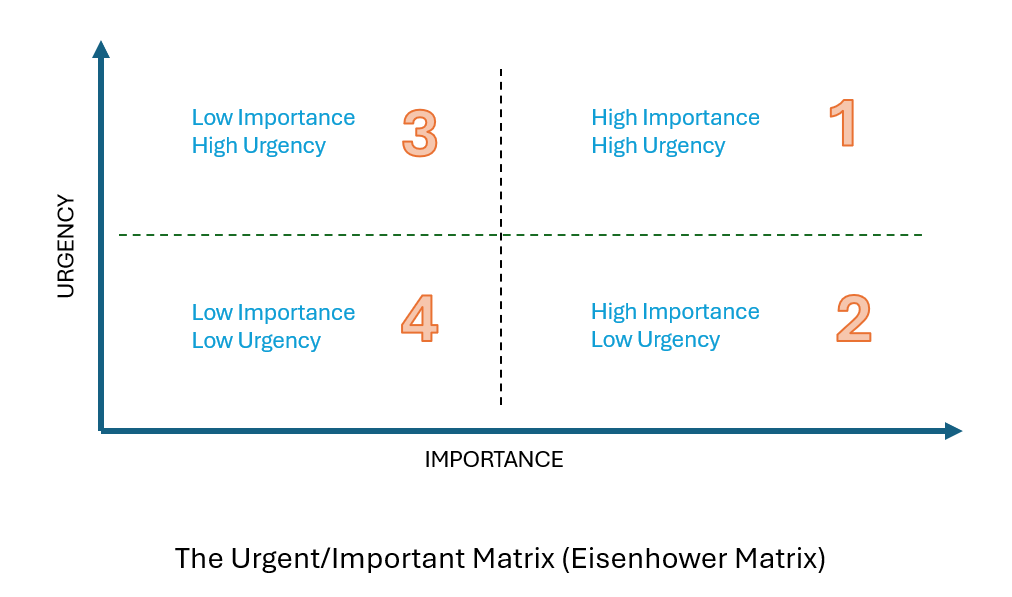
This tool divides tasks into four categories, and descriptions based on the Forbes article by Benjamin Laker are:
1. Urgent and important: Tasks that require immediate attention. These should be done first. Prioritising these tasks ensures that you address immediate challenges while moving towards your main objectives.
2. Important but not urgent: Activities that are important but do not have a pressing deadline. Setting aside time to address these can prevent them from becoming urgent. By dedicating effort to these tasks before they become emergencies, you can cultivate steady progress and an initiative-taking style.
3. Urgent but not important: Tasks that demand immediate attention but do not necessarily contribute to your long-term objectives. Identifying tasks in this category can help you find opportunities to delegate and thus free up time for more significant activities.
4. Neither urgent nor important: Activities that do not contribute to your goals and do not require immediate action. These should be minimised or eliminated. Often, these tasks can include distractions, time wasters, or activities done out of habit rather than necessity. Recognising and reducing time spent on these tasks can significantly increase productivity and ensure that your energy is focused on what truly matters.
By categorising tasks using the Urgent/Important matrix, you concentrate on what matters, reduce time spent on less significant activities, and make informed decisions about what to tackle next.