How to be a great DO Part 5
This month, Rebecca Thompson explores how to turn a technical lens dispense into a story the patient understands…
There is a familiar moment in practice when technical knowledge meets real life. A patient has had their eye examination, chosen a frame, and now needs lenses.
For the dispensing optician, this is where the real translation begins: taking a prescription, a chosen frame, a lifestyle, a budget and a whole host of lens possibilities, then turning them into a recommendation that makes sense to the person in front of them.
We think about index, coatings, corridor length, lens design, aberration control, blue light, occupational lenses, bespoke measurements and many other things. All of these need to be accurate, and some may be more important than others, but accuracy alone does not create understanding.
Patients rarely buy a lens feature because it sounds technically impressive, they buy the benefit they can picture. They buy reduced ‘glare’ when driving home in the dark, they buy easier screen use at the end of a long working day. They buy confidence when walking downstairs in varifocals, they buy lenses that make life feel simpler, safer or more comfortable.
The work, then, is not only to know the specification, it is to translate it into something patients understand and value.
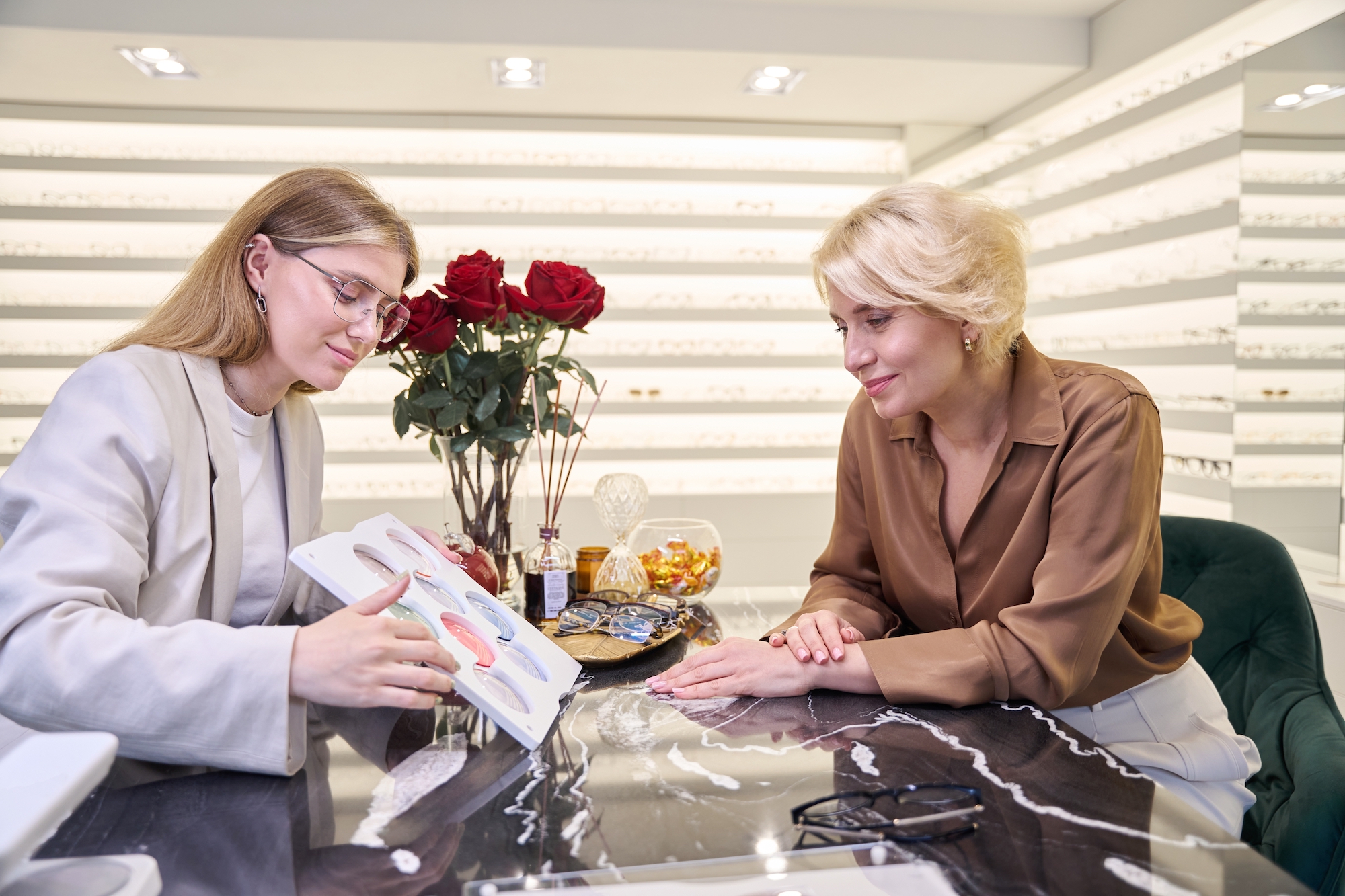
Patients buy the lens benefits they can visualise
From product knowledge to patient language
Optical professionals are trained to understand lenses in technical terms, but patients experience lenses in human terms – and that is the gap we need to bridge.
An anti-reflection coating is not just a surface treatment; it is clearer night driving, better eye contact, fewer distracting reflections on video calls, and lenses that look better in photographs.
Thinner lenses are not only about index; they are about confidence in the frame the patient has chosen, comfort on the face, and not feeling as though their prescription has dictated their style.
An occupational lens is not simply a lens category. It is a more comfortable working day for someone moving between a laptop, phone, paperwork and people across the room.
Photochromic lenses are not simply light-responsive technology. They are convenience, fewer swaps between glasses and sunglasses, and a more comfortable day moving between indoors and outdoors.
This doesn’t mean we always have to oversimplify (patients after all deserve accuracy and the key facts), but they also deserve explanations that make sense away from the practice environment.
Ensuring this understanding is taken away benefits practices too; a patient who has a clear, repeatable understanding of what they bought and more importantly how it benefits them, is more likely to tell others something positive.
Start with the life, not the lens
A useful shift in this direction is to begin with the patient’s day rather than the product catalogue.
Before describing a lens option, ask what the lens has to do for them. Do they drive at night? Work across multiple screens? Spend time outdoors? Read in bed? Teach? Garden? Cycle? Move between meetings, paperwork and presentations?
Not only that, but what is their current lens not doing, that they’d like it to do better?
This changes the conversation. Instead of presenting a list of upgrades, the dispensing optician is building a recommendation around lived experience. The phrase, “This would help because…”, is often more powerful than any technical explanation that follows.
“This would help because you told me your eyes feel tired by 4pm.”
“This would help because you drive home in the dark most evenings.”
“This would help because you want this frame to look as good with your prescription as it does on the tray.”
That small bridge between what the patient has said, and what the professional recommends, is where trust is built.
Value has to be visible
One of the challenges in optics is that some of the most valuable work is almost invisible. Patients can see the frame; they can touch it, try it on, compare colours and shapes. Lens value is much harder to see (until it’s been made). Much of the value sits in design, measurement, advice, fitting, aftercare and the judgement of the person dispensing it. That means value has to be made visible through language and process.
This is also where commercial confidence matters. Communicating value is not the same as recommending an upgrade. It is giving the patient enough understanding to make a good decision.
When a dispensing optician avoids the better option because they feel awkward discussing price, the patient may leave with something less suited to their life.
Good dispensing is not about selling the most expensive lens. It is about explaining the right lens well enough that the patient can judge its value for themselves. A good explanation does not need to be long. In fact, it is often better when it is short and specific.
“This lens gives you more usable vision for the way you work” is easier to understand than a detailed explanation of lens design.
“This coating helps reduce reflections and keeps the lens clearer for longer” is more useful than listing every layer or feature involved.
The aim is not to remove the science, it is simply to make the science meaningful.
Judgement behind the recommendation
The dispensing optician sits in a particularly important position because they are often the person who turns a prescription into something the patient can actually live with. That requires more than product knowledge, it requires judgement.
In 2026, patients can arrive with more information than ever before, but not always more understanding. They may have looked online, compared prices, read reviews or heard conflicting advice from friends. More information can help, but it can also make decisions feel harder. This is where the dispensing optician’s role becomes more valuable, not less.
A good recommendation filters the noise. It considers the prescription, the chosen frame, the patient’s work, hobbies, confidence, budget, previous experience and tolerance for change. It does not overwhelm the patient with every technical possibility. It explains the most relevant option clearly enough for them to understand why it matters.
This is not ‘just selling lenses’, it is professional judgement made visible.
Value starts before the dispense
Practices can also think beyond the dispensing desk. Communicating value does not only happen when a patient is sitting in front of you choosing lenses. It happens in the community, long before someone needs new glasses.
School visits, local talks, workplace sessions, community events and local press features can all help position the practice as a useful, trusted voice. Done well, they show that optical care is about more than appointments and prescriptions. It is about children learning comfortably, adults managing screen-heavy work, drivers feeling safer at night and people understanding how vision affects daily life.
A school visit might help children understand how eyes work and why glasses are nothing to feel embarrassed about. A local press article might explain why regular eye examinations matter, what parents should notice, or why visual comfort matters for modern working life.
A talk to a local business group might focus on screen fatigue, workstation habits and lens choices for different tasks. This is useful visibility.
For independent practices especially, it helps build familiarity and trust before a patient ever walks through the door.
Beyond the lens
The future of lens communication is not more jargon, it is better translation.
Technical features still matter. Innovation matters, as does product design. But the patient does not experience a lens as a specification sheet. They experience it on a rainy drive, in a classroom, at a laptop, on a walk, in a meeting, or while reading at the end of the day.
The modern dispensing optician is not there to recite every feature, they are there to make the right recommendation understandable. The more clearly we connect lens choices to those moments, the easier it becomes for patients to understand value.
Beyond the lens is where the real story begins.
Rebecca Thompson FBDO is a dispensing optician, eyewear strategist, founder of Eyestyle Studio and writer of Eye Style, a weekly journal exploring the business, design and the future of optics.