Children’s eye health in the UK

New research shows parents confusion around their child’s eye health
ABDO, the College of Optometrists and the OSA have partnered in a new campaign to raise awareness of the importance of children’s eye tests and better signposting for parents to children’s eye care professionals on the high street.
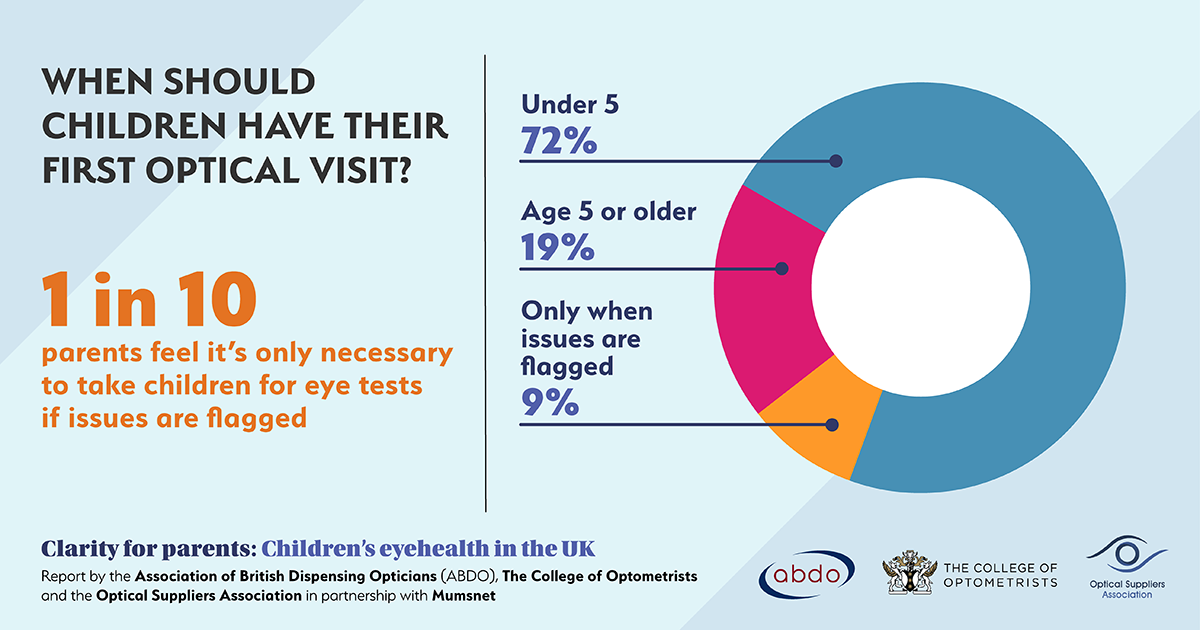
Nearly one in ten parents or carers (9%) will only take their child for their first visit to the optician if and when an eye health or vision issue arises, reveals a new Children’s Eye Health Report by ABDO, the College of Optometrists and the Optical Suppliers’ Association (OSA).
The three organisations came together to commission research with 1,008 parents on Mumsnet to explore parents’ awareness of the importance of children’s eye tests, eye health and the support they can expect.
The report reveals that UK parents are confused about when and where to go for children’s eye care advice and treatment. Over half (53%) of surveyed parents would go to straight to their GP for an eye infection issue and over a third (34% ) would go to their GP for an eye discomfort issue instead of seeking advice at their local opticians. One in twelve parents (8%) would visit their GP or call NHS 111 if their child was experiencing a slight change in vision rather than making an appointment at their local opticians.
Better signposting to eye care professionals on the high street would prevent parents making unnecessary appointments with their GP, as eye care professionals based at local opticians practices can offer specialist eyecare advice and in the majority of cases manage the condition without further referral.
Misinformation about children’s eye care
Many parents believe misinformation about eye care: over one in four parents and carers (28%) polled in the Mumsnet survey incorrectly believed that eye exercises can help slow the progression of short-sightedness (myopia), and one in five (20%) believed it’s legal to buy children’s prescription glasses online.
Confusion is also apparent around the different roles within an opticians and the support parents can expect from the NHS if their child needs glasses.
The findings of the research have enabled us to make clear recommendations to healthcare policymakers and service providers and provide guidance to parents.
Our recommendations for national health and care service providers
- Update all guidance online across the UK to signpost parents and carers to their local opticians as their first port of call for eye health services and advice. This will also prevent parents from booking unnecessary GP appointments or unnecessarily accessing other healthcare services and free up time for other childhood medical appointments
- Personal child health records, known as the ‘red book’, should always include advice about how and why parents and carers should take their child for regular eye tests every 1-2 years from the age of 3–4 years. This would ensure parents are aware of the importance of regular early eye tests and know where to go for eye health services
Our guidance for parents and carers
- Take children for regular NHS funded eye tests from age 3–4 years old every 1-2 years, unless advised otherwise by your optometrist
- If parents or carers have any concerns about their child’s eyes before this age, do not delay. Contact your local opticians or speak to your health visitor
- If your child does need glasses, help with the cost is available from the NHS. Ask for advice and help from the practice dispensing optician on what lenses are most appropriate for your child’s prescription and for help with choosing a frame that fits correctly
Children’s eye health in the UK report
-
 Children’s eye health in the UK report
1.56 MB

Resources for members
Below are resources to help dispensing opticians deliver exemplary children’s eyecare in their practices.
Focus on… myopia
Find all the latest research and product information on myopia in our clinical hub.
Professional certificate in paediatric eyecare
Develop advanced skills and knowledge in different aspects of paediatric eyecare, including myopia management, with the professional certificate in paediatric eyecare. The postgraduate course is available to qualified dispensing opticians, contact lens opticians and optometrists registered with the General Optical Council, or CORU in Éire.
This course will enable practitioners to develop advanced skills and knowledge in different aspects of paediatric eyecare, including myopia management.
Child safeguarding – You can access this through your CPD dashboard
eyecareFAQ
Members have access to eyecareFAQ graphic’s to share on social media and your websites, these can be accessed here.
eyecareFAQ have a range of FAQs including children’s eyecare basics, myopia and amblyopia, you can find all the children’s FAQ topics here.