ABDO CPD: Self-directed learning

Six to eight people is ideal for an effective discussion
In 2022, the General Optical Council (GOC) opened up the possibility of self-directed learning (SDL) as counting towards a GOC registrant’s regulatory requirement when it introduced a new scheme for continuing professional development (CPD). This change brought the sector closer towards the mandatory CPD schemes managed by other UK healthcare regulators, providing individuals with greater freedom to personalise their career-long learning journeys in developing their scope of practice.
However, recent data provided by the GOC reveals that during the first three-year CPD cycle, very few registrants took up the opportunity to undertake non-provider-led learning, with only four per cent of CPD uploaded to the My GOC web portal falling into this category1.
Such low up-take of SDL may be unsurprising to many readers. For those who participated in the GOC’s former continuing education and training (CET) scheme, where clear lines were drawn on what was possible and what was not, suddenly being able to decide that some form of ‘non-prescribed’ learning is accepted might feel like unfamiliar (and unnerving) territory. However, a step into the unknown can be a leap into the future, with greater freedom to tailor a personal development plan (PDP) to your specific career aspirations.
One form of SDL that is relatively easy to undertake and evidence is registrant-led peer review; it ensures you have everything to hand as you are discussing your own patients. In the former GOC CET scheme, registrants had to go through an approval process to undertake registrant-led peer discussion; in the new CPD scheme, registrant-led peer review is a much simpler process of submitting the evidence of what occurred.
In particular, registrant-led peer review is a great tool to bring together the multidisciplinary team in a practice. Creating cases to discuss, based on patients who have attended the practice, gives registrants the opportunity to explore different encounters the patient experiences across their journey, and how working effectively as a multi-disciplinary team can support better patient care.
Steps to getting started
Here are six simple steps to help set up your own registrant-led peer review…
Step 1: When and where?
You will need to set a date and time for your peer review event, which could be in person or held online. If you are running it online, you should use a video conferencing platform that can provide a timed record of who attended, such as Zoom or Teams. The peer review session must last for a minimum of one hour.
Step 2: Who?
Who will be in the peer review group? Will it be the practice team? If so, this will likely be a mix of dispensing opticians and optometrists. Or will it be for a specialty group only, such as contact lens opticians or independent prescriber optometrists? Deciding on these points will help you define the target group(s). The cases you are going to discuss must be relevant to the scope of practice of each of the professional roles you identify as your target groups. You also need to consider the group numbers. An ideal group size is six to eight for an effective discussion. If you have more than 10 people attending, you will need to break into two or more smaller groups.
Step 3: What?
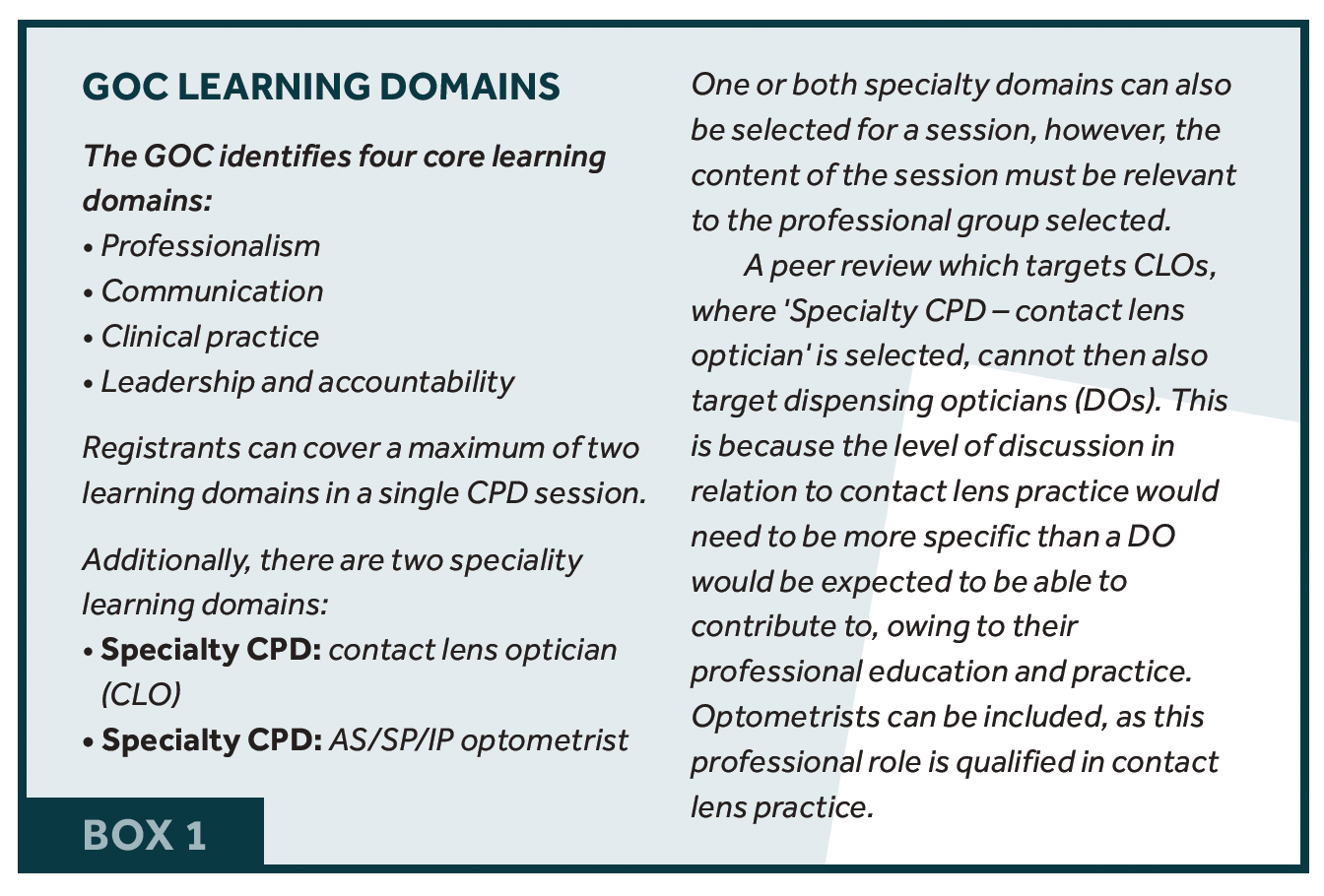 Ideally you need to consider a theme for your peer review. Will you cover cases in a specific clinical area, such as myopia management or cataract patients? Or maybe you want to discuss cases across the practice setting that will help you explore issues that have been highlighted in the patient journey and, therefore, may cover professional or leadership discussions.
The content of your cases will help you identify the GOC learning domains the peer review will cover (see Box 1). You should have a minimum of two cases to discuss over one hour, but this will depend on how complex the cases are. Typically, a peer review session tends to cover three to four cases.
Step 4: How?
Once you have identified your theme and learning domains, you need to select some patient cases for discussion. You could use your patient cases, or you could ask the people who will be attending the peer review to submit their own cases relevant to the theme that they want to discuss with peers.
You want to consider cases where having your peers discuss it may help you and others to manage a similar situation well in the future. Or, where you had an unusual or memorable case where sharing it may support your peers to provide good patient care if they encounter something similar.
Using the results of audits can help identify areas in practice that could be improved, and it may be possible to find some patient cases that can help brainstorm best practice. You can find a case template in the Professional Development Toolbox on the ABDO website and some guidance/articles on writing up different types of cases that may help you get started. Remember: you must fully anonymise your patient cases before you share any details either verbally or in writing.
STEP 5: Learning outcomes
Although official learning outcomes are not required to be created for registrant-led peer review, it is good practice to do this at the beginning of the process, so everyone understands what they should get out of the session.
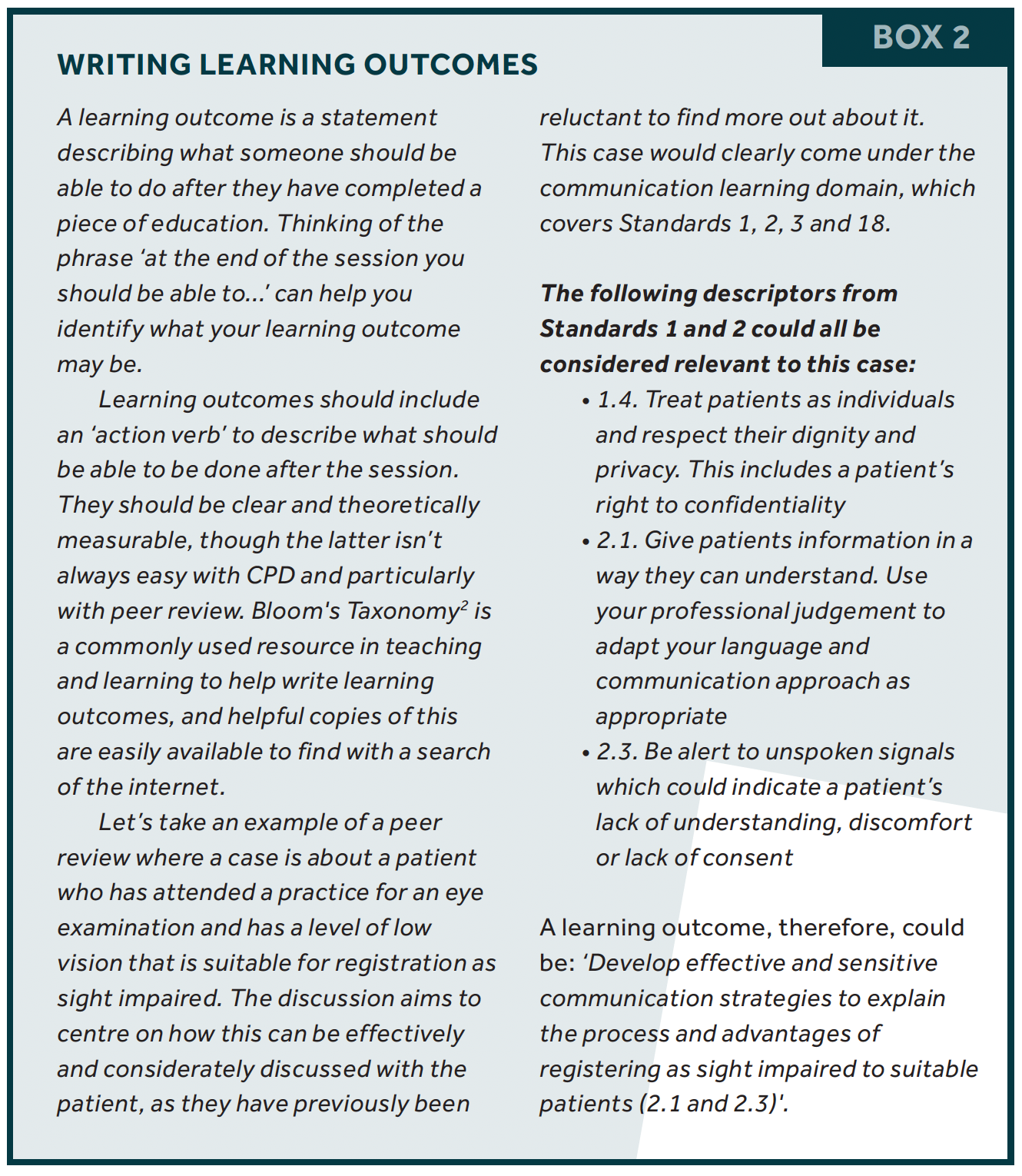 A CPD session would usually have between two and four learning outcomes. Depending on how your theme comes together, you may choose to write these before you decide what cases you include, or after these have been submitted to you. Your learning outcomes will need to relate to specific standards from the Standards of Practice for Optometrists and Dispensing Opticians, and these will need to link to the learning domains for the session (see Box 2). Once the learning outcomes have been created, these will need to be shared with the people taking part in the peer review.
Step 6: Evidence for GOC submission
Once the peer review has taken place, all registrants who attended will need to submit their learning to the GOC using the ‘Self-directed’ box. They will need to provide the usual reflective learning statement as well as evidence of what took place and when. An email with the time, date and location of the event, and confirmation of who attended, would be suitable. Additionally, the anonymised copies of the cases discussed can be uploaded as supporting evidence.

ABDO’s CPD team is here to help
Additional support
The ABDO professional development team is available to answer any questions from members about running a self-directed peer review. Simply telephone 01206 734155 or email abdocpd@abdo.org.uk
The GOC provides information on its website about SDL, including registrant-led peer review, which can be found found on the GOC website.
References
1. General Optical Council. Data on file. 2025.
2. Bloom B S. Taxonomy of Educational Objectives 1956. Allyn and Bacon, Boston, MA. Copyright © 1984 by Pearson Education.
This article first appeared in the September 2025 issue of Dispensing Optics.