Alzheimer’s eye imaging study published
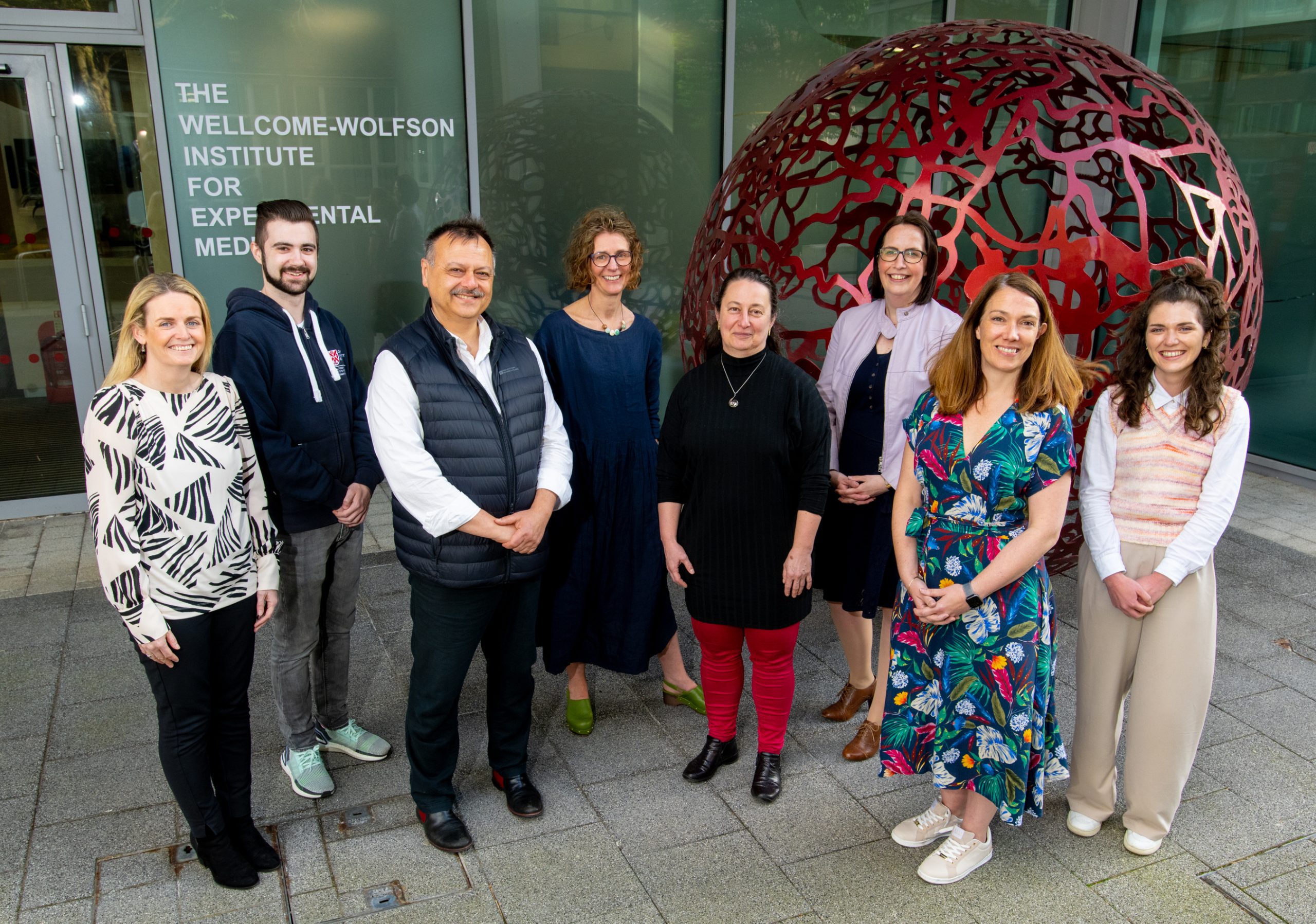
The REVEAL research team
A world-first ultrawide-field eye imaging study in adults with Down syndrome has found that abnormal blood vessels in the retinal periphery of the eye can be seen before clinical symptoms of Alzheimer’s disease begin to show.
The study was led by a research team from Queen’s University Belfast, and the results have been published in the Journal of Alzheimer’s Disease.
First author on the study is Jamie Mitchell, a PhD student under the supervision of the principal investigator on the study, Professor Imre Lengyel, a researcher from the Wellcome-Wolfson Institute for Experimental Medicine at Queen’s University Belfast.
Professor Lengyel said: “Our study is the first clinical investigation to show that blood vessels in the retina of the eye thin more rapidly along their paths and small vessel abnormalities are present in the peripheral retina in adults with Down syndrome.”
To carry out their study, the team looked at adults with Down syndrome aged 27 to 53 years from the UK who did not yet display signs of Alzheimer’s disease, and compared their retinal scans to a group of adults of a similar age without Down syndrome.
Using eye tests to create detailed images of the eye’s internal structures, the researchers also looked at the lens at the front of the eye, then the retina and the choroid, and compared the retinal layer thicknesses of both groups.
Joint principal investigator of the research, Dr Lajos Csincsik, commented: “These exciting research results suggest eye imaging can help detect and monitor Alzheimer’s disease in people with Down syndrome, potentially enabling earlier diagnosis, treatment interventions, and an easier way to track its progression.”
“Eye imaging is quick, simple and costs a fraction to that of other ways to diagnose Alzheimer’s disease, such as brain scans, so there are huge benefits to both professionals and patients,” said Professor Tunde Peto, the clinical ophthalmology lead of the study and professor of clinical ophthalmology from the Centre for Public Health at Queen’s University Belfast.
Dr Richard Oakley, associate director of research and innovation at Alzheimer’s Society, which part-funded the study, said: “People with Down’s syndrome have a greater risk of developing dementia, and earlier than people without the condition, so this is an encouraging study suggesting we could use the eye as a window to the brain and identify the early warning signs that someone with Down’s syndrome may go on to develop dementia.
“This study is the first to show changes in blood vessels in the eye can be seen in someone with Down’s syndrome, which weren’t seen in people of a similar age without Down’s syndrome. However, this was a small study and didn’t track participants to see if they went on to develop dementia, so more research is needed to understand whether the blood vessel changes do indeed mean an individual will go on to develop Alzheimer’s.
“This research shows it’s critical we explore every avenue to accurately diagnose people early in the development of their dementia, so they can access the treatment and support they need. Help us continue to fund research by donating at alzheimers.org.uk/forgetmenotappeal,” added Dr Oakley.
Studies are now in progress in Belfast in collaboration between Queen’s University and Ulster University to explore the findings further.
The REVEAL Study is currently recruiting participants with Down syndrome, mild cognitive impairment, and those who have been diagnosed with very early stages of Alzheimer’s disease. Those interested can contact Professor Imre Lengyel.
The research is supported by Optos, the Deep and Frequent Phenotyping Study from the Medical Research Council, and Alzheimer’s Society.