Business Bites: Active listening

Active listening is the number one skill and key component to communication
Greek philosopher Epictetus is attributed with the saying: “We have two ears and one mouth so that we can listen twice as much as we speak”.
This quote is relevant to everyone at all times, no matter what we are doing. It suggests that by listening twice as much as we speak, we can:
- Gain a better understanding of different perspectives
- Absorb knowledge ahead of offering our own thoughts leading to more worthwhile contributions
- Cultivate active listening, an important skill for better communication
- Avoid speaking excessively on matters we don’t fully comprehend.
The number one skill and key component to communication is active listening. You will likely find yourself in a situation when managing your team where active listening will aid understanding of the employees situation and thoughts.
In her Forbes article, ‘Active listening skills: what they are and why they’re important‘, Rachel Wells tells us that – “it is essential to understand best practices for effective communication. One such best practice, coined into popularity by American psychologists Carl Rogers and Richard Farson in 1957, is that of active listening”.
Understanding meaning and intent
Active listening means going beyond simply hearing the words that another speaks. It is about seeking to understand the meaning and intent behind the words and requires you to be a mindful and focused participant in the communication process.
Active listening techniques include:
- Showing interest by maintaining good eye contact
- Noticing and using non-verbal cues
- Paraphrasing what has been said to confirm understanding
- Withholding judgement and advice
Active listening keeps you engaged in the conversation and makes the other person feel heard and valued. It demonstrates that you value the other person’s needs and thoughts. Ultimately, the process of active listening builds trust and respect, strengthening the relationship, putting others at ease and encouraging them to open up more to you.
Here’s more detail of how you can practise active listening:
- Be fully present: active listening requires being fully present in the conversation, enabling you to concentrate on what is being said. You will want to put away your phone, ignore distractions, and shut down your internal dialogue
- Pay attention to non-verbal communication: Albert Mehrabian, Professor Emeritus of Psychology at the University of California is best known for his research into the relative importance of verbal and non-verbal messaging
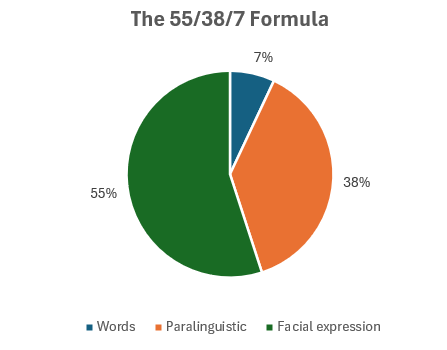
The 55/38/7 Formula is known as Mehrabian’s Rule of Communication
Mehrabian’s Rule of Communication
Here is a more precise representation of Mehrabian’s findings that is typically cited, and often referred to as the 55/38/77 Formula:
- Seven per cent of a message pertaining to feelings and attitudes is in the words that are spoken
- Thirty-eight per cent of a message pertaining to feelings and attitudes is paralinguistic (the way that the words are said)
- Fifty five per cent of a message pertaining to feelings and attitudes is in facial expression
Show supportive behaviours
Given that the listener’s input in active listening is limited, it’s important to show support through positive, non-verbal communication and avoid distracted behaviours such as crossing your arms. Smiling and nodding are recommended to show you’re paying attention, and creates a pleasant atmosphere. So, pay attention to these non-verbal cues.
Maintain eye contact
This tells the other person that you are present and listening to what they are saying. But do be careful to not hold eye contact for too long, which can make the other person feel uncomfortable.
Ask open questions
This encourages the conversation to flow and enables you to really understand others’ needs. Examples of open questions include: “What did you think about that?”; “How would you like to move forward?”; or “How do you think you could have responded differently?”
Reflect what you hear
Paraphrase and summarise what you have heard. Once the other person has finished speaking, rephrasing what has been said in your own words confirms understanding. This process shows attentiveness and reinforces the purpose of active listening, while avoiding personal comments or judgements. This ensures that you have understood what they have said, and it makes the individual feel validated and listened to.
Be patient
This allows the individual to speak without interruption, giving them time to say what they are thinking. It is important that you do not fill any periods of silence with your own thoughts. It is also important that you do not change the subject abruptly, as this can suggest that you are feeling impatient and even bored.
Withhold judgement
Remain neutral and non-judgemental, which will help the individual feel more comfortable sharing their thoughts. It’s important to avoid expressing your personal judgement when listening to someone. It makes the conversation a safe zone, where they can trust that they won’t be shamed, criticised or blamed.
Connson Locke in her LSE blog tells us: “Our standard way of thinking about leadership sees leaders as influencers, i.e. influencing people and directing work. But leaders also have a second key role, as facilitators. In some situations, leaders benefit from stepping out of the influencer role and instead taking on the different non-verbal demeanour of a more neutral listener, in order to facilitate the sharing of information and collaboration in decision-making. My research explored the non-verbal behaviours which underpin the facilitator role, ones that signal ‘open’ communication, such as uncrossed arms and legs, body oriented toward the other person, and nodding and maintaining eye contact while listening.”
So remember: active listening will help you develop a strong relationship with your team members, enabling you to more easily support their development and growth.