Carpe diem: seizing the day at the BCLA
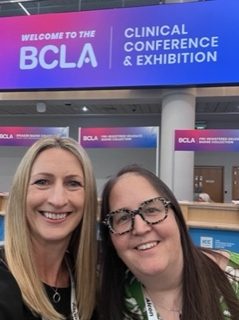
Suzanne with workshop co-presenter, Diane Nash
Contact lens optician ‘influencer’ Suzanne Dunn reports on the 2025 British Contact Lens Association (BCLA) clinical conference and exhibition, held from 5-7 June at the Birmingham International Convention Centre…
Did you seize the day at BCLA? I certainly did. The atmosphere was buzzing as we registered on day one – spotting familiar faces for a quick “Hello, I’ll catch up with you later” and a few “It’s great to meet you”s.
The event kicked off with an insightful introduction from the new BCLA CEO and dispensing optician (DO), Brad Parkes, followed by the BCLA president elect, Byki Huntjens, and current president, Sarah Farrant. Then came a difficult decision to make: what will my personal conference programme look like? Should I listen to this lecture, learn about that research, develop my skills in a workshop, or maybe push myself out of my comfort zone and get involved in a discussion?
With so much choice on offer, it was a tough call because I wanted to be involved in everything.
New myopia insights
With a plan of action made, I began my first morning by listening to an International Myopia Institute (IMI) update, chaired by Professor James Wolffsohn. This provided key revisions and new insights across a suite of white papers – including risk factors, binocular vision, pre-myopia and definitions and classification.
The session concluded with a look ahead to 2050, when myopia prevalence is projected to reach 50 per cent globally, equating to 307 million people experiencing visual impairment, with 109 million (35 per cent) directly attributable to myopia.
To address this looming public health issue, speakers introduced the Continuum of Myopia Care – a 10-point model highlighting proactive and responsive care strategies:
1. Managing early-onset myopia
2. Identifying at-risk children by age six
3. Early counselling and preventive education
4. Ongoing checks from ages six to nine
5. Prompt initiation of treatment in new cases
6. Delivering evidence-based interventions
7. Setting appropriate treatment goals
8. Tailoring treatment duration based on axial elongation
9. Managing adult progression
10. Treating myopia-related disease
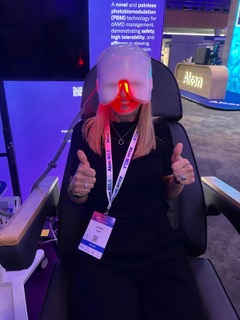
Experiencing low level light therapy on the Topcon stand
Next I headed to a discussion workshop addressing the role of dry eye and ocular surface homeostasis in successful contact lens wear. Four industry leaders (Professor Jennifer Craig, Professor Fiona Stapleton, Keyur Patel and Sarah Farrant) delivered the workshop in bite-sized pieces focusing on homeostasis, technology and lifestyle.
A new learning for me this year was all about low level light therapy (LLLT) for dry eye. Consequently, I found myself at the Topcon stand in the exhibition hall to experience its Eye-Light solution for dry eye therapy; I felt like I was auditioning for a part in a new Hollywood sequel for Phantom of the Opera – but with a fabulous health twist.
Team work makes the dream work
My highlight of day one was, of course, the discussion workshop on cases from a minor eye conditions services (MECS) anterior eye clinic. I was honoured to be invited to deliver this CPD workshop alongside my colleague, Diane Nash. We were delighted with the turnout, which included contact lens opticians (CLOs), a DO training to be a CLO, as well as optometrists – some of whom had achieved their independent prescribing (IP) qualification.
After a brief introduction on MECS for CLOs and the training pathway, we dived right into the first case. This saw delegates differentially diagnosing between a contact lens peripheral ulcer and microbial keratitis, and the various pathways for management. Case two covered foreign body removal – including who, how and when to be cautious. Viral keratitis was the discussion point in case three, centering on advice given to patients.
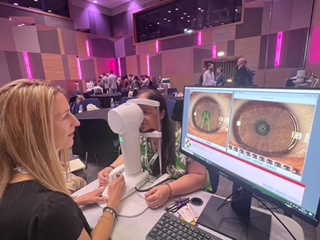
MECS cases workshop with Diane
Case four focused on working as a multi-disciplinary team in practice, and discussed the role of MECS-accredited CLOs in delivering this element of patient care. For some IP optometrists in the room, this was the first time that they had heard of the MECS-accredited CLO role – and many welcomed the part such professionals could play in practice.
Finally, three CLOs engaged with us to begin their MECS training, so we ticked the box of increasing awareness of extended services CLOs. It was great to feel like we had been ‘influencers’ for the day – without quite making the under-25-year-old bar normally required of such a vocation.
Seeing the light
Day two for me began with a skills workshop on ‘Demystifying the science of myopia management’ with Indie Grewal and Nicky Latham. My main take-home was the value of engaging with young myopia patients in greater depth – and specifically asking what they would like to do when they’re older.
Why? Some occupations have visual restrictions and if we, as practitioners, do not talk about the impact of increasing myopia, then we are failing our patients. Furthermore, using the evidence to engage the patient’s parents is vital, with websites such as the IMI’s useful in providing clinical summaries and infographics that may be used in practice.
Light was a focus of this year’s conference: not only how it can impact dry eye therapy but also its significance in myopia management. Research shows that outdoor light intensity, 10 to 100 times higher than indoors, plays a protective role against myopia onset, potentially through the retinal dopaminergic pathway, which influences axial elongation.
The emerging message is clear: increased time outdoors should be viewed not as a medical intervention but a public health imperative. Red light therapy is showing early promise, although some safety concerns remain. Blue light may also come under greater scrutiny as a treatment option in upcoming clinical trials.
Whilst more research is needed, the consensus is that time spent outdoors is one of the most effective, evidence-supported strategies in myopia management. In the UK, this can sometimes be a challenge – but hey, that’s what waterproofs were invented for.
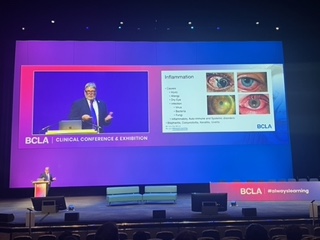
Professor Nick Rumney discuses anterior eye inflammation
CooperVision presented on innovations in myopia management and the impact of its on-going research studies into its own MiSight contact lenses. They followed the journey of one particular study participant, who may not have achieved his dream of joining the Army without having been involved in trials of the lens since a young age.
The keynote presentation by Professor Nicholas Rumney – ‘Detecting and managing anterior eye inflammation’ – served as a stark reminder of the importance of differential diagnosis and the impact inflammation has on ocular health. A long-time supporter of ABDO and dispensing opticians, Nick received an ABDO Honorary Fellowship in 2016.
Always something to learn
BCLA president, Sarah Farrant, presented a powerful session on reminding practitioners that dry eye is a disease, and is often under-estimated. During ‘A dry eye story to tell’, three real-life patients told their emotional stories on stage of how debilitating this chronic disease is, and the emotional and psychological toll it has had on their everyday lives.
One patient described a form of blood therapy to treat their symptoms, while another told of the constant pain that stopped them from going outdoors. The message from these patients was to really listen, to act and think holistically – and relate any findings to the patient’s immunology status.
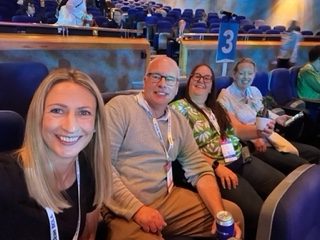
With ABDO’s Max Halford and Alex Webster
For something a little different, I attended another skills workshop on specialty lenses, which included fitting and assessing scleral contact lenses, orthokeratology, interpreting topography maps on the Eaglet Eye and measuring topography on the Medmont. Whilst this isn’t my role in everyday practise, the challenge of learning something new is exciting and ties in with the hashtag for this year’s BCLA clinical conference – #AlwaysLearning.
The BCLA clinical conference certainly delivered what it promised in the way of CPD, discussions, hot topics, technology, skills and, of course, networking. It was motivational, inspiring and box ticking. My only regret was being unable to attend more sessions and soak up more information. I’m reluctant to cite that old cliché – ‘eye opening’ – but it really was.
In my preview to the conference in the May issue of Dispensing Optics, I quoted Mark Twain: “Twenty years from now, you will be more disappointed by the things that you didn’t do than by the ones you did do”. Make sure the next BCLA clinical conference in 2027 isn’t one of your ‘didn’t do’s. Make a note of it today – because it will come around before you know it…
Suzanne Dunn BSc (Hons) FBDO (Hons) CL MBCLA qualified as a contact lens optician in 2010, gained her Advanced CL qualification in 2017, and currently works for several practices across a large multiple opticians. She is a senior ABDO contact lens practical examiner and theory marker, an ABDO CPD facilitator and has created CPD for ABDO, Eyecare and Perceptive. She is a previous recipient of both the AOP and Optician Contact Lens Practitioner of the Year awards. Suzanne is a MECS-accredited contact lens optician.
With thanks to Max Halford, ABDO clinical and policy director, for additional insights.